
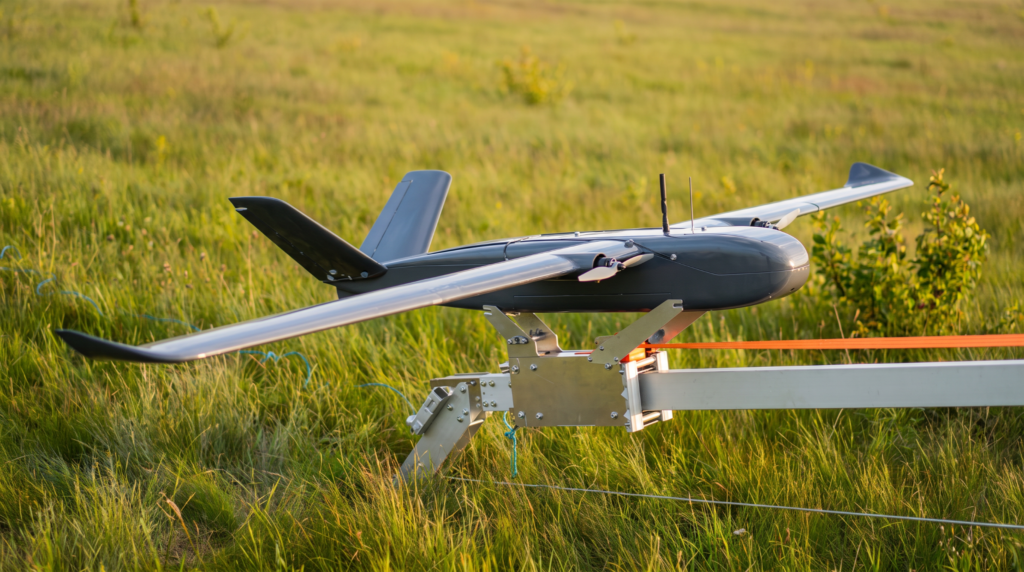
Military UAVs have evolved from specialised assets into a significant part of modern defence operations. As their roles expand, organisations seeking reliable unmanned systems and long-term technological partnerships must understand the global manufacturing landscape.
Why Military UAV Manufacturers Matter in Modern Defence
Partnering with a drone company for a military programme is no longer a standard equipment purchase. UAVs are now sophisticated aerial systems that support reconnaissance, mapping, communications relay, target acquisition, and high-precision strike missions. Their effectiveness affects how quickly units understand their operational environment and receive accurate data.
The manufacturer assembles more than an aircraft. Airframe design, software, data links, payload, operator interfaces, training and maintenance must work as a unified system. A technically capable UAV might not perform properly if it is vulnerable to jamming, difficult to deploy, or incompatible with existing command-and-control infrastructure.
Military customers, therefore, consider factors beyond key technical specifications. They need suppliers that can adapt platforms to mission requirements and provide support throughout the product lifecycle.
Global Military UAV Market Overview
The global military unmanned aerial vehicle (UAV) market is valued at approximately USD 18.55-34.85 billion in 2026. It includes a wide range of unmanned systems – from compact hand-launched aircraft to long-endurance ISR platforms, FPV drones and loitering munitions. Advances in AI, sensors, navigation and secure communications are also enhancing what smaller platforms can achieve.
These days, military uav manufacturers range from multinational prime contractors and established aerospace corporations to specialised engineering enterprises with narrow specialisation. They usually compete on product capacity, innovation, and the quality of their supporting networks. Demand is being shaped by the need for faster decision-making and reduced personnel exposure.
Regional priorities determine demand as well. Some customers need extended-range ISR platforms, while others focus on maritime surveillance or operation under electronic warfare. Local production requirements, export regulations, and supply chain resilience are equally critical factors influencing manufacturer selection and operational readiness.
How Military UAV Manufacturers Are Classified
Manufacturers can be classified by platform type and scale. One group develops small tactical UAVs for short-range reconnaissance, another concentrates on medium- or long-endurance aircraft with advanced sensors and communications payloads. Meanwhile, an additional segment produces loitering munitions and strike UAVs.
Companies also differ in scope. An aero drone company may incorporate aircraft engineering and rely on partners for software or payloads. On the other hand, vertically integrated manufacturers develop airframes, ground control stations, and mission-planning tools within one ecosystem.
When considering a military drones company, keep in mind the distinction between commercial suppliers adapting civil products and manufacturers building systems initially to defence requirements. Expertise in encrypted communications, GNSS-denied navigation, and military integration is important as well.
How to Evaluate and Select a Military UAV Manufacturer
Evaluation should begin with the mission – buyers need to determine the required endurance, range, deployment time, operating conditions and level of autonomy. Evidence is also essential. Consider flight trials that represent performance with the intended payload and under real weather, terrain and communications conditions. It’s also critical to examine resistance to interference and system behaviour when connectivity is degraded.
The assessment must cover crew size, training, field repairs, spare-parts delivery, and integration with existing C2, GIS, or intelligence systems. Military requirements evolve quickly, so the drone company must turn operational feedback into practical updates as it assembles an aircraft. The right choice is not simply the unmanned system with the longest range or lowest price, but a partner that can deliver reliable aerial capability, sustain it, and improve it over time.